AI Without the Fog: 20 Ideas That Make Modern Models Click
AI Without the Fog: 20 Ideas That Make Modern Models Click
Introduction
Modern AI can feel oddly split in public conversation. On one side, people talk about it as if it were magic. On the other, people reduce it to buzzwords and dashboards. Neither view is very helpful.
What most developers, writers, students, and curious engineers actually need is a mental map. Not a PhD thesis. Not a hype thread. Just a clear explanation of the core ideas that show up again and again across machine learning, large language models, AI products, and modern tooling.
This post is my attempt to build that map.
It covers 20 essential AI concepts in a way that stays high-level but still technically honest. The goal is simple: if you understand these ideas, modern AI systems stop looking like a black box and start looking like an engineering stack with understandable moving parts.
To keep things practical, each concept comes with an original mini-visual and a fresh real-world analogy. The examples are mine, the diagrams are mine, and the writing is intentionally framed in a different voice and structure from the popular explainers many of us have read online.
Part 1: The Learning Foundations
1. Pattern Stacks Instead of Handwritten Rules
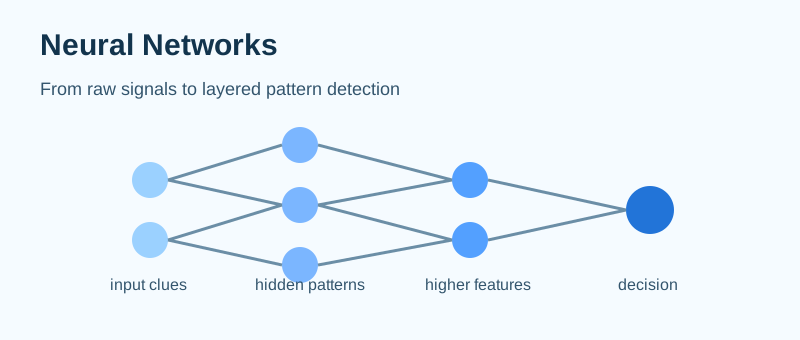
The first idea is the neural network.
A neural network is not a brain, but it is inspired by layered signal processing. Instead of writing thousands of hard-coded rules like “if this pixel shape appears, then it might be a cat,” we give the system many examples and let it learn its own internal weights.
You can think of it like a coffee-tasting team. One person notices bitterness, another notices aroma, another notices texture, and a final reviewer combines those signals into a decision. Each layer extracts something slightly more abstract than the one before it.
This is why neural networks became so dominant. They scale better than brittle rule-based systems when the real world is noisy, messy, and full of exceptions.
2. Reusing Intelligence Instead of Starting From Zero
The second idea is transfer learning.
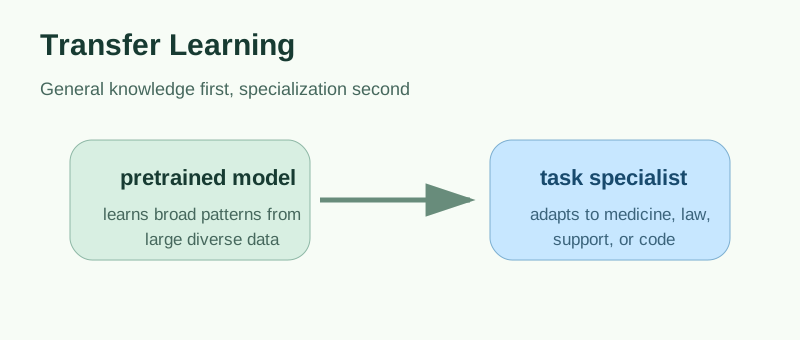
Training a good model from scratch is expensive. Transfer learning says: first learn general patterns on a broad task, then adapt that knowledge to a narrower one.
A good analogy is hiring a skilled architect to design a hospital after years of designing many buildings. The architect is not starting from nothing. They already understand load, light, circulation, and structure. They just need domain-specific adaptation.
That is what transfer learning does in AI. It lets models carry forward useful representation and then specialize.
3. Breaking Language Into Machine-Sized Pieces
The third idea is tokenization.
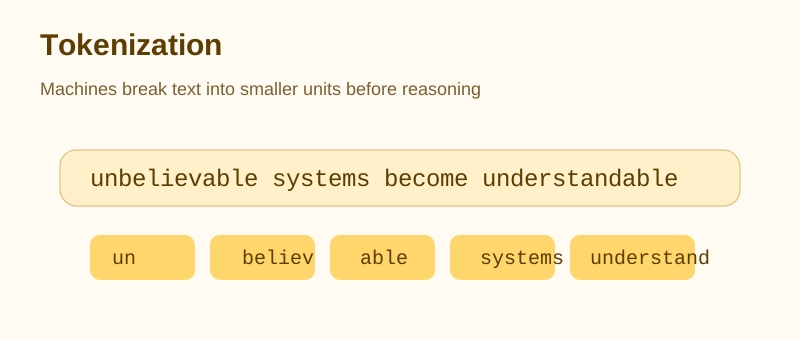
Models do not see text the way humans do. They do not directly “read” words or sentences in the human sense. Instead, text is split into smaller units called tokens. A token might be a whole word, part of a word, punctuation, or a short chunk.
Why does this matter? Because every language model you use is operating on tokens, not plain text. Cost, speed, context length, and output limits all depend on token count.
Think of tokenization like chopping a long road trip into map segments. The trip is still one journey, but the navigation system processes it step by step.
4. Meaning as Coordinates in Space
The fourth idea is embeddings.
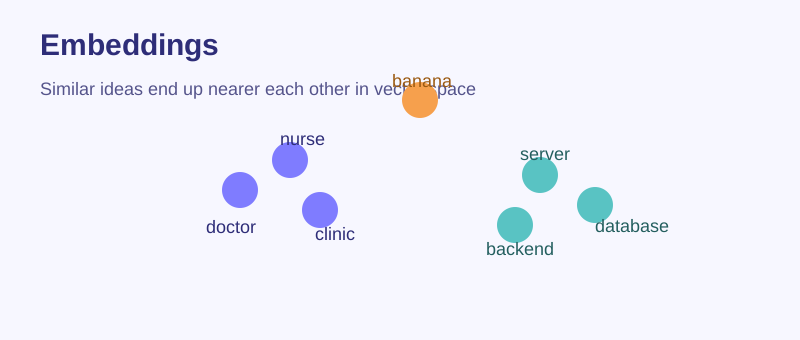
An embedding is a numerical representation that captures meaning or similarity. In embedding space, concepts that are related often sit closer together than concepts that are unrelated.
For example, doctor and nurse may land nearer each other than doctor and mountain. Similarly, database may sit closer to server than to banana.
A useful analogy is a city map where restaurants cluster in one area, schools in another, and hospitals in another. The coordinates are not the things themselves, but they preserve useful relationships.
Embeddings are the quiet backbone of semantic search, recommendation systems, clustering, retrieval, and RAG.
Part 2: The Architecture Behind Modern Language Models
5. The Spotlight That Decides What Matters
The fifth idea is attention.
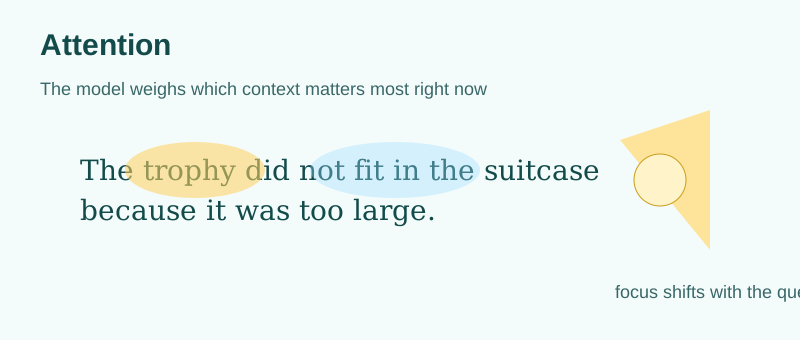
Attention helps a model decide which parts of the input deserve more focus when interpreting a specific word or token. In the sentence “The trophy did not fit in the suitcase because it was too large,” attention helps the model reason about what “it” probably refers to.
A good analogy is a detective board. Not every clue matters equally at every moment. The relevant clue depends on the question being asked.
Attention made models dramatically better at handling long-range relationships inside text and sequences.
6. The Assembly Line That Changed AI
The sixth idea is the transformer.
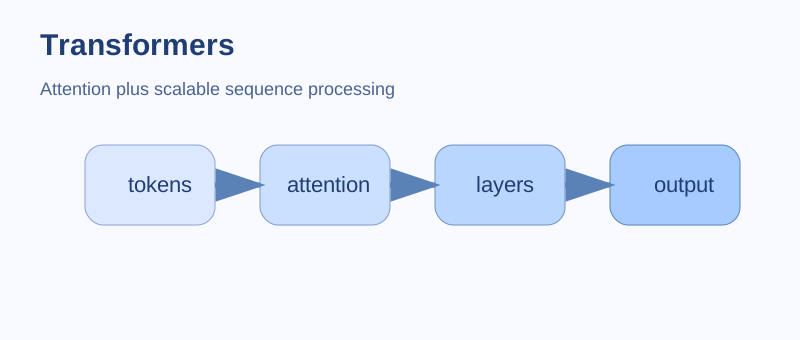
The transformer is the architecture that turned attention from an interesting technique into the foundation of modern language AI. Instead of processing words strictly one step at a time like older recurrent models, transformers can look across the full sequence more effectively.
That architectural shift made large-scale training dramatically more practical. It is a big reason systems like GPT, BERT, Claude, Gemini, and many others became possible.
If attention is the spotlight, the transformer is the full stage design that makes the spotlight useful at scale.
7. The Giant Text Engines We Call LLMs
The seventh idea is the large language model, or LLM.
An LLM is essentially a very large transformer-based model trained on massive amounts of text so it can predict likely continuations and learn rich language patterns.
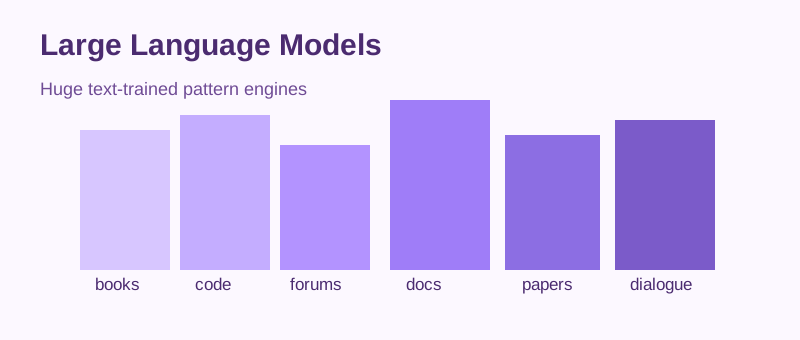
The phrase “language model” sounds small, but the modern form is enormous. These systems absorb statistical regularities across books, forums, code, documentation, research, and more. That scale is why they can summarize, draft, explain, translate, and write code.
An LLM is less like a fixed encyclopedia and more like a gigantic pattern engine trained to model how language is usually structured.
8. The Size of the Model’s Working Table
The eighth idea is the context window.
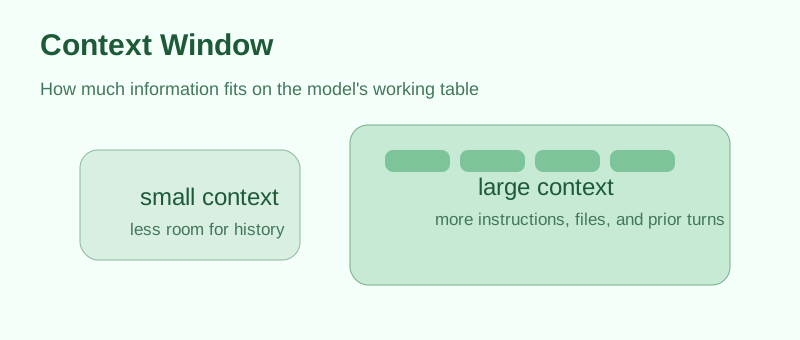
A context window is the amount of text, code, or tokens a model can consider at one time. You can think of it as the size of the model’s working table. A tiny table forces constant forgetting. A larger one lets the model keep more instructions, history, and reference material in play.
This matters more than many people realize. Large context windows improve document analysis, code navigation, long conversations, and multi-step tasks. But they do not automatically guarantee understanding. A bigger desk is useful, but the person working at the desk still needs judgment.
9. The Creativity Dial
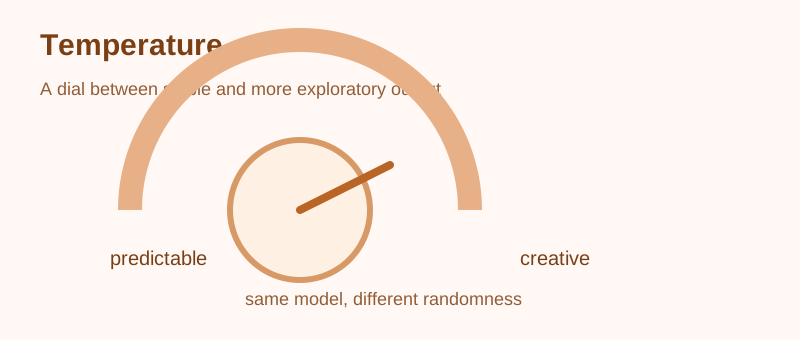
The ninth idea is temperature.
Temperature controls randomness during generation. Lower temperature makes outputs more conservative and repeatable. Higher temperature allows more variety and surprise.
It helps to imagine a jazz ensemble. At low temperature, everyone sticks closely to the score. At high temperature, there is more improvisation. Both modes can be useful depending on whether you want stability or exploration.
For deterministic tasks like extraction or formatting, lower temperature is often better. For brainstorming and creative writing, a bit more freedom can help.
10. Fluent Language, Weak Grounding
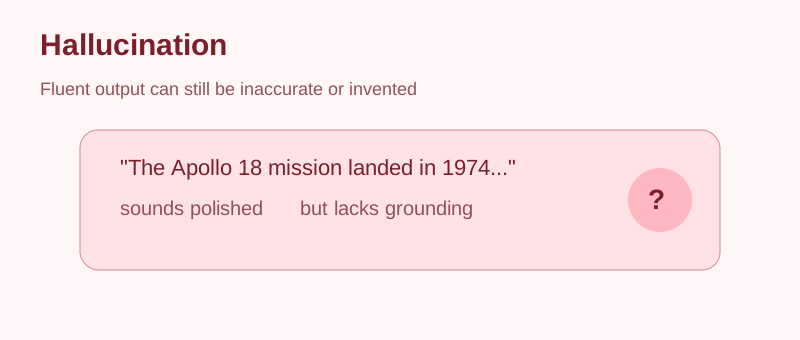
The tenth idea is hallucination.
Hallucination happens when a model produces text that sounds confident and coherent but is wrong, unsupported, or invented. This is one of the most important realities to understand about AI systems.
Hallucination is not simply “a bug.” It emerges from the fact that language models are optimized to produce plausible continuations, not guaranteed truth. If the model lacks grounding, retrieval, or verification, fluency can outrun accuracy.
That is why high-stakes use cases need checks, citations, tools, or retrieval systems around the model.
Part 3: How Models Become More Useful
11. Turning a General Model Into a Domain Specialist
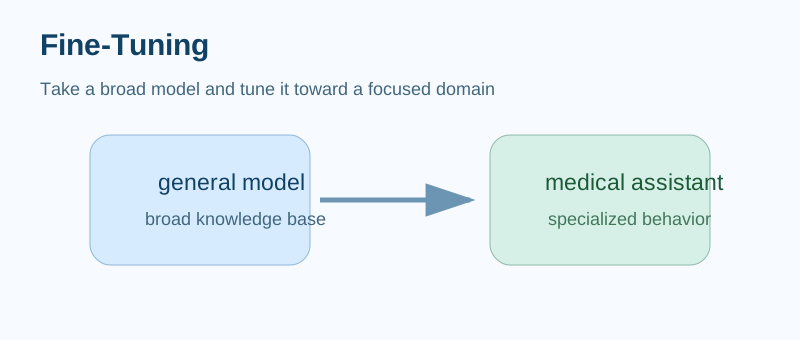
The eleventh idea is fine-tuning.
A base model may understand general language, but a team often needs something narrower: legal drafting, biomedical extraction, customer support tone, fraud detection, or internal coding conventions.
Fine-tuning takes a broadly trained model and continues training it on domain-specific data so its behavior shifts toward the target use case.
This is similar to residency training in medicine. A doctor first learns general foundations, then specializes in something more focused and operationally demanding.
12. Teaching Models Through Human Preference
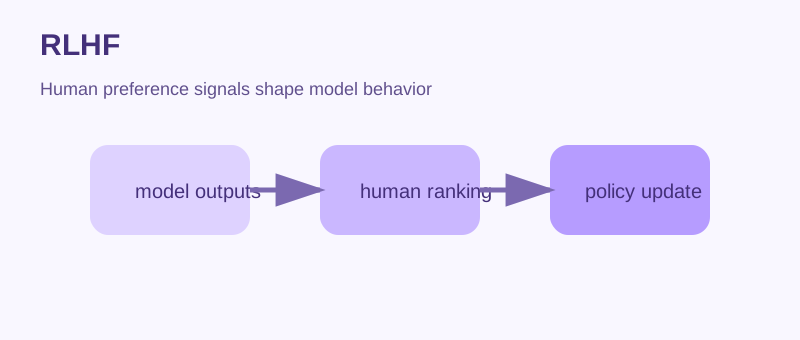
The twelfth idea is reinforcement learning from human feedback, usually shortened to RLHF.
After a model learns general patterns, teams often want it to be more helpful, safer, better aligned with user expectations, or better at following instructions. RLHF is one of the techniques used to shape behavior using human preference signals.
The basic intuition is simple: humans compare outputs, a reward model learns those preferences, and the system is further optimized toward what people tend to rate as better responses.
It is less like teaching facts and more like coaching behavior.
13. Small Adapters, Big Impact
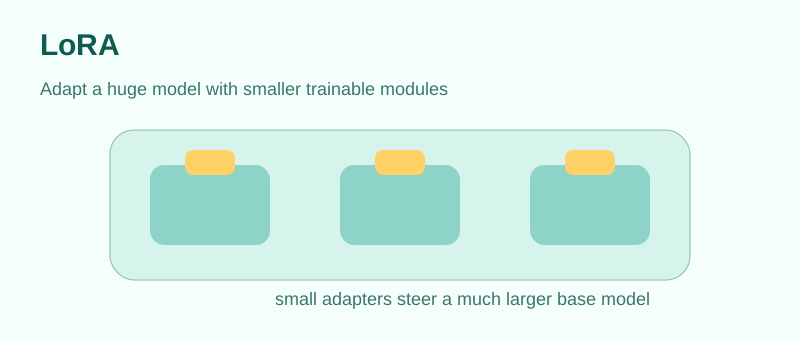
The thirteenth idea is LoRA, short for Low-Rank Adaptation.
LoRA is a clever way to adapt large models without retraining every parameter. Instead of rewriting the whole machine, we inject smaller trainable components that nudge behavior in useful directions.
An everyday analogy is adding modular attachments to a professional camera. You do not rebuild the camera body every time you want a new capability. You add focused extensions.
This matters because full fine-tuning can be expensive. LoRA makes customization lighter and more accessible.
14. Shrinking Models So They Travel Better
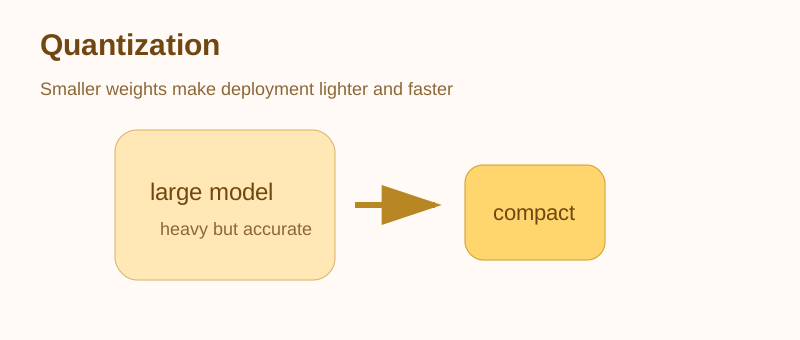
The fourteenth idea is quantization.
Quantization reduces the precision of model weights so the model uses less memory and can run faster or on smaller hardware. In practice, this is one of the reasons AI can move from giant cloud servers into laptops, phones, edge devices, and smaller inference boxes.
The tradeoff is that compression can sometimes reduce quality. So quantization is often a balancing act between efficiency and performance.
Think of it like packing for a trip. A smaller suitcase is easier to carry, but you have to be thoughtful about what you keep and what you leave behind.
Part 4: Using Models More Intelligently
15. Asking Better Questions to Get Better Work
The fifteenth idea is prompt engineering.
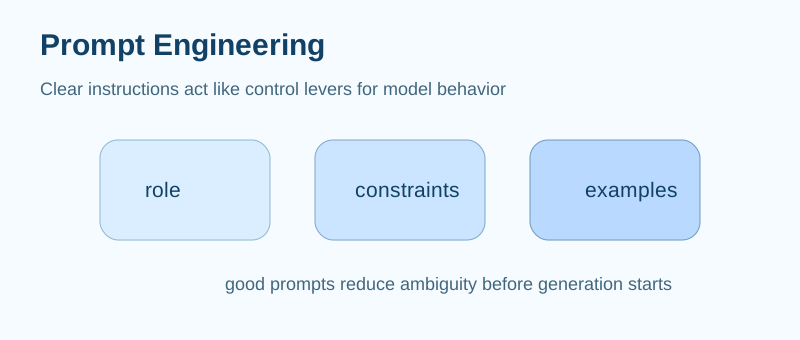
Prompt engineering is the craft of structuring instructions so the model has a better chance of producing useful output. This includes clarity, examples, constraints, format guidance, role framing, and context selection.
It is not about magical phrasing. It is about reducing ambiguity.
When people say “AI is amazing” or “AI is useless,” a lot of the difference comes down to whether the task was framed well. Better prompts do not fix every limitation, but they often unlock much better performance from the same model.
16. Solving Problems One Deliberate Step at a Time
The sixteenth idea is chain-of-thought reasoning.
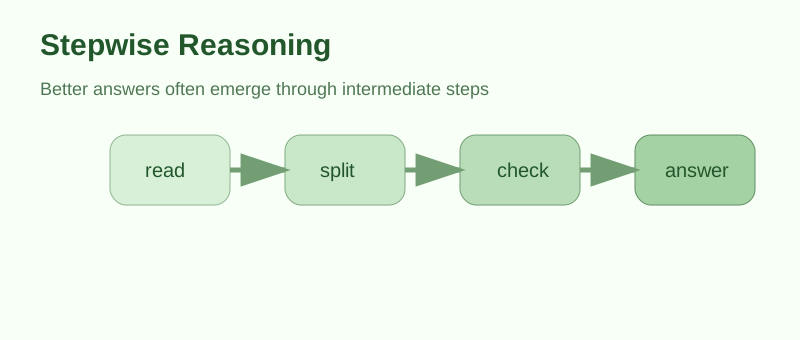
At a high level, this refers to breaking a problem into intermediate reasoning steps rather than jumping straight to an answer. In practice, models often perform better on complex tasks when guided to decompose the problem.
The real value here is not mystique. It is decomposition. When a problem is hard, forcing it into smaller checkpoints can reduce mistakes.
This is the same reason experienced engineers sketch a plan before changing production systems. Good reasoning often depends on visible intermediate structure.
17. Giving the Model a Library Card Before It Answers
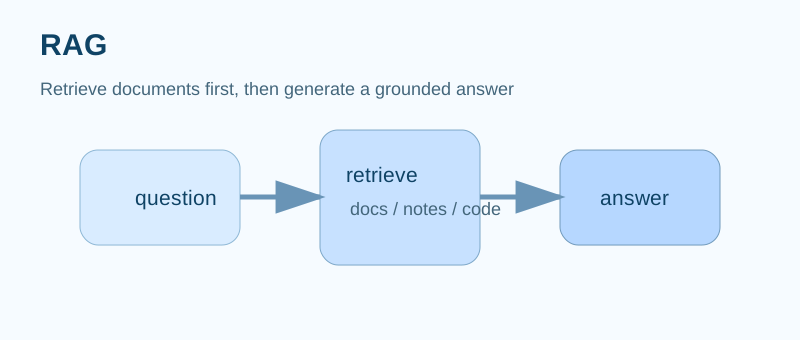
The seventeenth idea is retrieval-augmented generation, or RAG.
RAG improves a model by letting it retrieve relevant external information before generating an answer. Instead of asking the model to rely only on what it absorbed during training, you let it pull in documents, notes, policies, or code snippets at runtime.
This is one of the most practical ideas in applied AI because it reduces hallucination and makes answers more grounded in current or organization-specific material.
RAG is often what turns a generic chatbot into a useful company assistant.
18. Searching by Meaning Instead of Exact Keywords
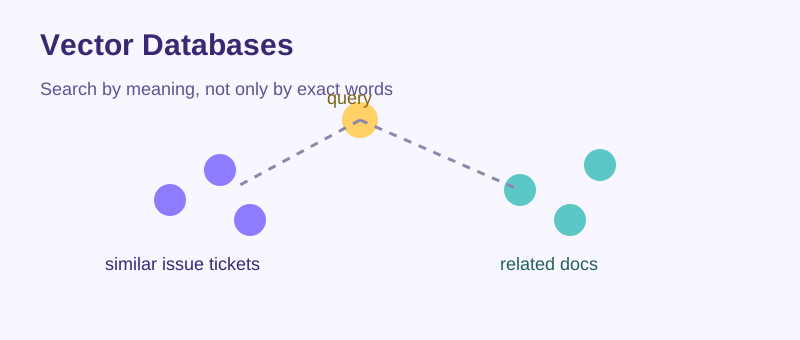
The eighteenth idea is the vector database.
A vector database stores embeddings so systems can search based on semantic similarity rather than exact string matching. This is what lets a system find documents that are about the same thing even when the wording differs.
If traditional search is like looking up a phone book by exact spelling, vector search is more like asking, “Show me the things closest in meaning to this idea.”
Vector databases are a key infrastructure layer behind RAG systems and semantic search products.
Part 5: The Systems Layer of Modern AI
19. Models That Do Things, Not Just Talk
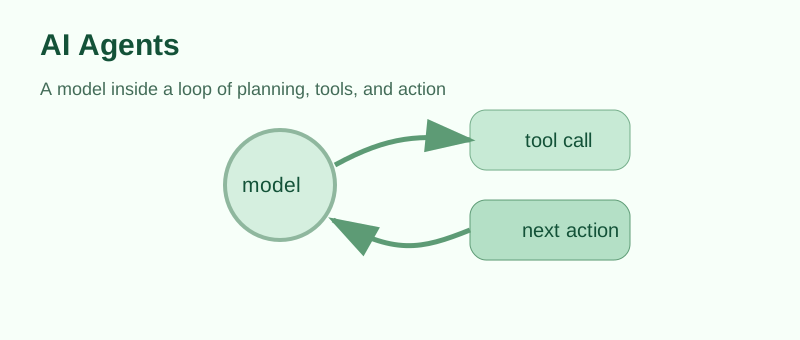
The nineteenth idea is the AI agent.
An agent is a system that uses a model inside a larger loop of planning, tool use, memory, and action. A plain chatbot mostly responds. An agent can observe, decide, call tools, revise, and continue.
This does not mean every agent is autonomous in some dramatic science-fiction sense. Often, it simply means the model is embedded in a workflow that lets it interact with files, APIs, browsers, or databases.
The key shift is from text generation to goal-directed behavior.
20. Creating Images by Removing Noise
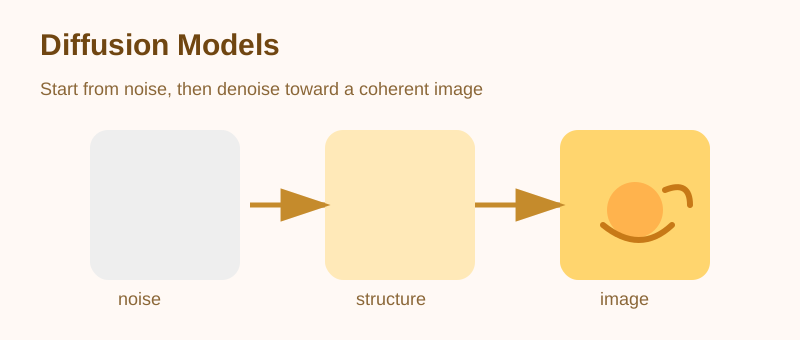
The twentieth idea is the diffusion model.
Diffusion models are a major family of generative image systems. Their core idea is elegant: start with noise, then gradually denoise it into a coherent image guided by learned structure and often by a text prompt.
That is very different from how people usually imagine image generation. The model is not painting from nowhere in one stroke. It is repeatedly refining a noisy starting point into something structured.
This idea has powered many of the image generation systems that made AI feel suddenly visible to the public.
How These Ideas Fit Together
The biggest mistake people make is learning these concepts as isolated trivia.
They are not isolated.
A realistic modern AI product often looks something like this:
- a transformer-based LLM
- operating over tokens
- constrained by a context window
- shaped by fine-tuning, RLHF, or LoRA
- guided by prompt engineering
- grounded using RAG
- backed by embeddings and a vector database
- wrapped in an agentic workflow
- deployed with quantization when efficiency matters
That is why understanding the stack matters. Once the pieces click, a lot of AI stops looking mysterious and starts looking like a design space with tradeoffs.
Where to Go Next
If you are a developer, start by learning three layers in order:
- Core model ideas: neural networks, attention, transformers, embeddings
- LLM behavior ideas: tokens, context windows, temperature, hallucination
- Applied system ideas: prompting, RAG, vector databases, agents
That path gives you a much stronger foundation than memorizing product names or chasing every weekly announcement.
Conclusion
AI becomes easier to reason about when we stop asking, “What is the one trick behind all of this?” and start asking, “Which layer of the system am I looking at?”
Sometimes the right concept is a training idea like transfer learning. Sometimes it is an architecture idea like attention or the transformer. Sometimes it is an application layer idea like RAG or agents. And sometimes it is simply an operational fact like context windows or quantization.
Together, these 20 ideas form a useful foundation. They will not make anyone an overnight researcher, but they will help you read AI news more critically, build better intuition, and ask far better technical questions.
That alone is a big upgrade from hype.
Suggested Reading
- Attention Is All You Need
- BERT: Pre-training of Deep Bidirectional Transformers for Language Understanding
- Language Models are Few-Shot Learners
- Training language models to follow instructions with human feedback
- LoRA: Low-Rank Adaptation of Large Language Models
- Retrieval-Augmented Generation for Knowledge-Intensive NLP Tasks
- High-Resolution Image Synthesis with Latent Diffusion Models