The Creative Machines Playbook: A Practical Guide to Generative AI
The Creative Machines Playbook: A Practical Guide to Generative AI
Introduction
Generative AI is one of those rare technologies that feels both familiar and strange at the same time.
It is familiar because we can see the outputs immediately:
- a paragraph
- an image
- a summary
- a song fragment
- a code snippet
- a chatbot response
And it feels strange because the system is not just retrieving stored answers. It is creating new content by learning patterns from vast amounts of existing data.
That distinction matters.
Traditional software is often built around explicit rules. Traditional machine learning is often built around prediction or classification. Generative AI goes one step further: it learns the structure of data well enough to produce fresh examples that look meaningful, coherent, and often surprisingly useful.
This post is a high-level but practical guide to generative AI. Think of it as structured notes for developers, students, and curious builders who want one clean mental model of:
- what generative AI is
- how it works
- how it evolved
- why GPT models changed the field
- what architectures power it
- how to evaluate and improve it
- what risks still matter
- where it is likely going next
What Is Generative AI?
Generative AI refers to AI systems that can create new content rather than only classify, rank, or label existing content.
Depending on the model and modality, that content may include:
- text
- images
- audio
- video
- code
- 3D scenes
- synthetic data
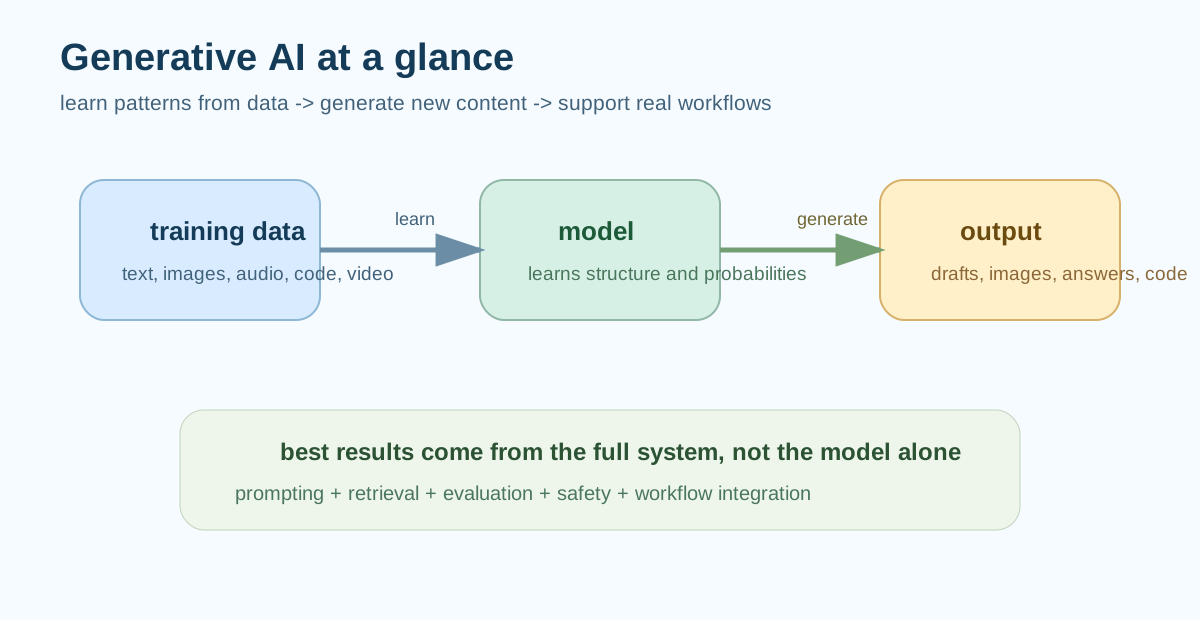
At a high level, the model learns patterns from training data and then uses those learned patterns to generate new outputs that are statistically plausible and contextually meaningful.
If a model learns enough about how stories are written, it can generate a story. If it learns enough about how faces are structured, it can generate a face. If it learns enough about source code, it can generate code suggestions.
This is why generative AI feels so versatile. The same broad idea applies across many different output types.
How Generative AI Works
The simplest explanation is this:
- A model is trained on a very large amount of data.
- During training, it learns patterns, structure, relationships, and probability distributions.
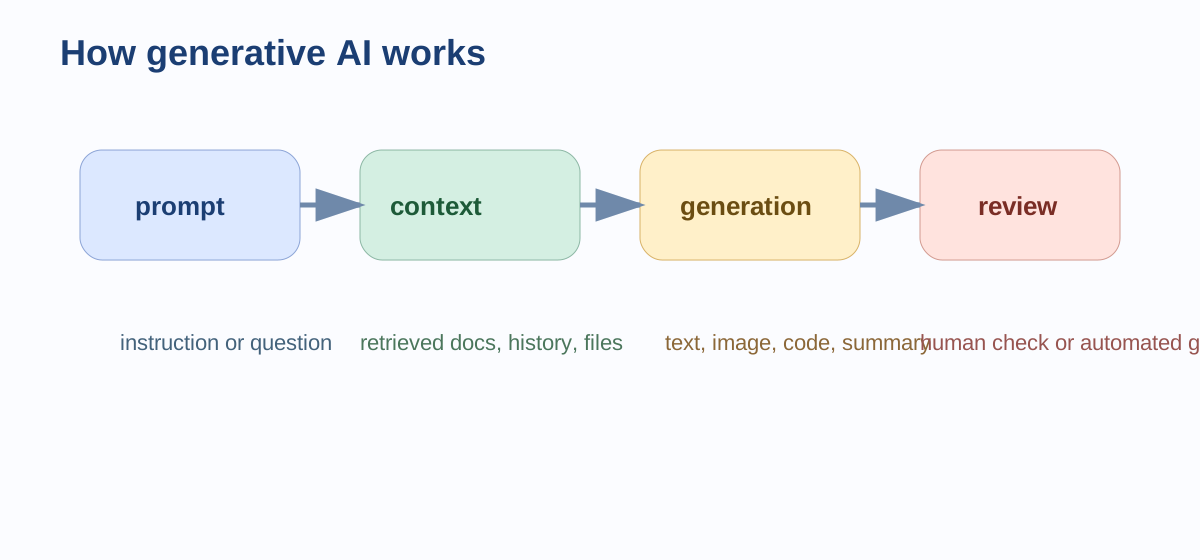
- During inference, it uses that learned structure to create a new output based on a prompt, context, or partial input.
In text generation, the model may predict the next token in a sequence.
In image generation, the model may refine random noise into a structured picture.
In code generation, the model may continue a function in a way that matches the syntax and intent of what came before.
The key idea is not memorization alone. The model is learning a pattern space that lets it produce new combinations, new continuations, and new compositions.
Think of a musician who has studied thousands of songs. They are not merely replaying one remembered tune. They have internalized structure, rhythm, transition, and style. That lets them improvise something new.
From Recognition to Creation
One of the most important conceptual shifts in AI is the move from recognizing data to creating data.
Earlier machine learning systems were often built for tasks like:
- spam detection
- fraud classification
- object recognition
- demand prediction
These are valuable, but they are mostly about judgment over existing inputs.
Generative AI emerged from the realization that if a model can learn the structure of data deeply enough, it may also be able to generate fresh data that follows the same structure.
For example:
- if a model learns what makes an email spam, it is doing discrimination
- if a model learns the deeper structure of email writing and can produce a new email, it is doing generation
That move from identify to create is one of the defining changes of modern AI.
Generative vs. Discriminative Models
This distinction is foundational.
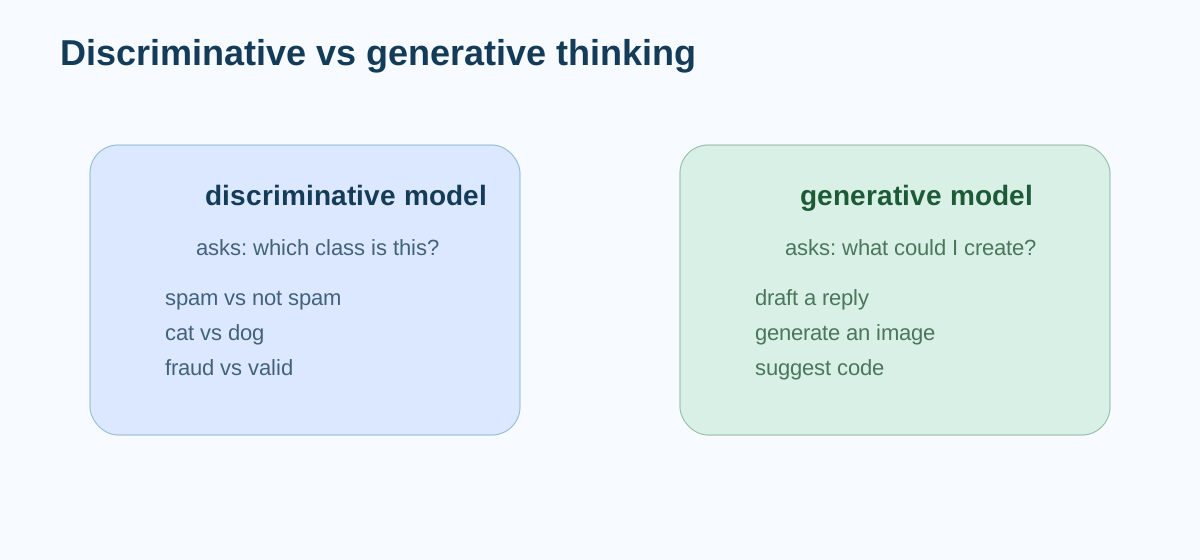
Discriminative models
Discriminative models learn to separate or classify.
Examples:
- cat vs. dog
- spam vs. non-spam
- fraud vs. valid transaction
- positive vs. negative sentiment
They answer questions like:
Which class does this input belong to?
Generative models
Generative models learn the structure of the data itself and can create new examples.
They answer questions like:
What could a plausible next example look like?
That is why the outputs of generative systems can feel creative. The system is not simply drawing a decision boundary. It is producing a new sample from a learned distribution.
The Evolution of Generative AI
Generative AI did not arrive in one dramatic leap. It emerged through several waves of progress.
Early statistical and probabilistic systems
Before modern deep learning, many generative ideas existed in probabilistic modeling, graphical models, and simpler sequence systems. These methods were useful, but limited in scale and expressiveness.
Deep learning changed the ceiling
As neural networks improved and compute became more powerful, models became better at learning rich structure from raw data. This opened the door to more realistic text, images, and audio generation.
Foundation models changed accessibility
Once large pre-trained models became reusable platforms instead of single-purpose research artifacts, generative AI became far more practical for products, APIs, and downstream applications.
The chat interface changed public adoption
Many people did not truly feel the power of generative AI until conversational systems made it directly interactive. Suddenly, a deep model stopped looking like a research paper and started feeling like a collaborator.
The GPT Timeline and Why It Mattered
When people talk about generative AI in public, GPT models are often the reference point. That is not because they invented every core idea, but because they turned several major research trends into highly visible products.
GPT-1
GPT-1 showed that unsupervised pretraining followed by adaptation could work surprisingly well for language tasks. It helped establish the usefulness of the transformer architecture for general language modeling.
GPT-2
GPT-2 made text generation feel noticeably more coherent and more flexible. It made people take large-scale language generation more seriously.
GPT-3
GPT-3 dramatically expanded scale and popularized the idea that one large pre-trained model could perform many tasks from prompting alone, often without task-specific retraining.
This was a major shift in how developers thought about AI interfaces.
GPT-4 and the multimodal turn
GPT-4 deepened instruction following and reasoning quality, and multimodal capabilities made it clear that future generative systems would not be limited to text.
The bigger story is not just version numbers. It is the cumulative impact:
- better fluency
- better context handling
- better instruction following
- broader applicability
- more productization
- more multimodality
That evolution pushed generative AI from novelty toward infrastructure.
How GPT-Style Progress Changed Generative AI as a Whole
The progress of GPT-like systems changed the field in several practical ways.
Better output quality
Generated responses became more coherent, better structured, and more usable in real workflows.
More useful general-purpose systems
Instead of training a custom model for every narrow task, teams could often begin with one strong base model and adapt it with prompts, retrieval, fine-tuning, or tool use.
More interest in multimodality
Once it became clear that one family of models could potentially connect text, images, audio, and tools, the entire industry started moving toward broader multimodal systems.
Stronger developer ecosystems
Better models created demand for:
- inference infrastructure
- vector databases
- prompt management
- evaluation frameworks
- AI agents
- safety layers
So the evolution of GPT models did not just improve text generation. It expanded the whole engineering stack around generative AI.
Foundation Models and Large Language Models
A foundation model is a broad model trained on massive, often general-purpose data that can later be adapted to many downstream tasks.
A large language model is one important kind of foundation model focused on language.
This distinction matters because generative AI is larger than text alone.
Foundation models may exist for:
- text
- image generation
- audio
- video
- multimodal understanding
- embeddings
So while LLMs dominate many current conversations, they are only one slice of a wider generative AI landscape.
Modalities in Generative AI
Generative AI is best understood through modalities, meaning the kind of data the system handles.
Text
- chat systems
- summarization
- translation
- writing assistance
- question answering
Images
- illustration
- concept art
- product mockups
- photo editing
Audio
- speech synthesis
- voice cloning
- music generation
Video
- scene generation
- animation support
- synthetic clips
Code
- autocomplete
- refactoring suggestions
- tests and documentation
3D and spatial generation
- scene reconstruction
- asset generation
- design workflows
The more multimodal these systems become, the more they resemble general creative infrastructure rather than single-purpose tools.
Core Mechanisms Behind Generative AI
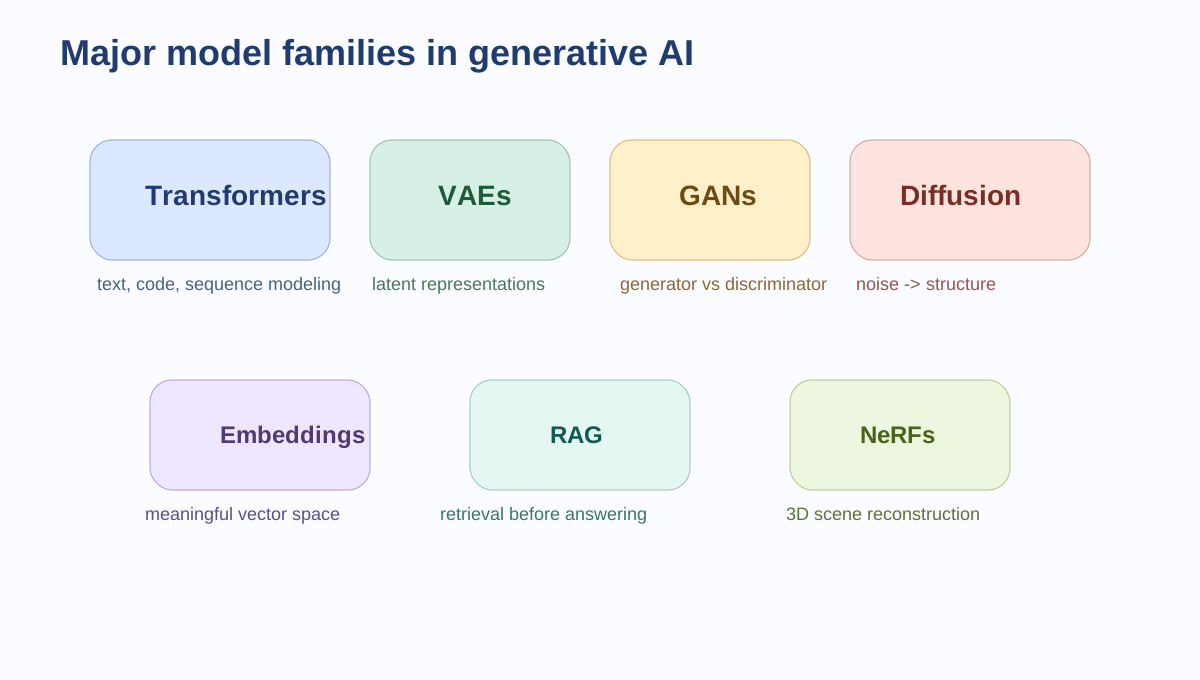
Different families of generative systems use different architectures. It helps to know the most important ones.
Transformers
Transformers are the dominant architecture behind modern large language models. They rely heavily on attention mechanisms and are especially strong for long-range sequence modeling.
Variational Autoencoders (VAEs)
VAEs learn a compressed latent representation of data and then decode from that representation to reconstruct or generate new samples. They are conceptually useful because they show how models can learn structured latent spaces.
Generative Adversarial Networks (GANs)
GANs use two networks in competition:
- a generator tries to create convincing samples
- a discriminator tries to tell real data from fake data
This adversarial setup pushed image generation forward dramatically, especially before diffusion models became dominant.
Diffusion models
Diffusion models generate outputs by starting with noise and progressively denoising it into a coherent image or sample. They are now central to many state-of-the-art image generation systems.
Embeddings
Embeddings are not a full generative architecture by themselves, but they are essential infrastructure for retrieval, similarity, semantic search, and grounding.
Retrieval-Augmented Generation (RAG)
RAG extends a model with external knowledge retrieval. It helps ground answers in documents, databases, or curated corpora instead of relying only on model memory.
Neural Radiance Fields (NeRFs)
NeRF-style approaches are important in 3D and view synthesis, where the goal is to reconstruct scenes or generate novel viewpoints from 2D images.
How We Actually Use Generative AI
The most useful way to think about generative AI is not “What is the model?” but “What job is the model helping me do?”
Here are some major application areas.
Content creation
- blog drafts
- marketing copy
- social posts
- story ideation
- image variations
Software engineering
- code completion
- explanation of unfamiliar code
- test generation
- migration assistance
- documentation drafts
Research and analysis
- literature summarization
- structured note generation
- report drafting
- trend extraction
Customer support
- conversational assistants
- response drafting
- triage workflows
- personalized explanations
Education
- tutoring
- quiz generation
- adaptive explanation
- language practice
Design and creative production
- mockups
- style exploration
- asset creation
- prototype visuals
Science and specialized domains
- protein design
- synthetic data generation
- medical assistance
- workflow automation
How to Use It in an Industry-Specific Project
Generative AI becomes much more valuable when paired with domain context.
If you are building in a specific industry, do not begin by asking:
Where can we insert AI?
Start by asking:
Which high-friction knowledge task is slow, repetitive, expensive, or hard to scale?
Good industry use cases usually involve one or more of these:
- summarizing complex documents
- retrieving knowledge from internal systems
- generating first drafts for human review
- transforming data across formats
- assisting specialists without replacing them
Examples:
- in healthcare, summarize clinician notes and retrieve guidelines
- in law, draft structured memos from large document sets
- in e-commerce, generate product copy variations
- in engineering, explain logs, code, and runbooks
- in education, personalize lesson explanations
The practical lesson is simple: generative AI works best when it is attached to a real workflow, real data, and a real review loop.
How to Evaluate Generative AI Models
Evaluation is one of the hardest parts of generative AI because the output is often open-ended.
Unlike a strict classifier, there may be many “acceptable” answers.
Still, strong evaluation usually looks at a combination of:
Quality
Is the output coherent, relevant, polished, and helpful?
Accuracy
Is it factually correct or grounded in the right source material?
Consistency
Does the system behave reliably across similar prompts and repeated runs?
Latency
How long does it take to respond?
Cost
Is the output quality worth the inference and operational expense?
Safety
Does the system avoid harmful, misleading, or policy-violating outputs?
Task success
Does it actually help the user complete the intended workflow better than the previous method?
For serious systems, human review is still very important. Benchmark scores alone rarely tell the full business story.
How to Improve Generative AI Systems
There is a common misconception that if the first output is weak, the model itself is weak.
Often the real issue is the system design around the model.
Here are the main levers that improve results:
Better prompts
Clarity, examples, formatting constraints, and task framing often improve quality immediately.
Better context
A strong model with poor context can underperform a smaller model with better retrieval.
Fine-tuning
When a domain is narrow and recurring, fine-tuning can shift behavior meaningfully.
RAG
Retrieval often improves factual grounding and domain alignment.
Tool use
Connecting models to calculators, search, APIs, databases, or code execution can improve correctness.
Human feedback loops
Review, correction, and preference signals are powerful sources of improvement.
Better evaluation
If you cannot measure what “good” looks like, it is very hard to improve the system systematically.
Prompt Engineering Still Matters
Even though modern models are stronger than earlier ones, prompt engineering still matters.
Not because there is a secret magic phrase, but because instructions shape behavior.
Good prompts clarify:
- the role
- the task
- the audience
- the format
- the constraints
- the success criteria
A vague prompt invites vague output. A structured prompt reduces ambiguity and raises the odds of useful results.
In practice, prompt design is often the cheapest improvement lever available.
The Practical Limits of Generative AI
Generative AI is powerful, but it is not a universal solution.
Important limitations include:
Hallucination
Models may generate plausible but false content.
Bias
Models can reproduce or amplify harmful patterns from training data.
Staleness
A model may not know the latest information unless connected to fresh sources.
Cost and latency
Large models can be expensive to run at scale.
Privacy and security risk
Sensitive data handling requires strong governance.
Evaluation difficulty
Open-ended outputs are harder to score cleanly than standard ML outputs.
Overtrust
Users may assume confidence equals correctness, which is dangerous in high-stakes settings.
So the real engineering task is not just making a model talk. It is deciding when to trust it, how to verify it, and where humans stay in the loop.
Ethical, Social, and Business Impacts
Generative AI is not just a technical shift. It is also a social and organizational one.
Workflows will change
Many tasks will become partially automated, especially first-draft, summarization, and support work.
Human review becomes more important, not less
As AI accelerates output, the ability to validate, prioritize, and correct becomes more valuable.
Intellectual property questions remain active
Questions around training data, style imitation, and content ownership are still evolving.
Education and skill development will shift
People may spend less time generating from zero and more time steering, evaluating, and refining machine-generated material.
Competitive advantage will come from system design
The biggest gains will likely not come from “using AI” in the abstract, but from combining:
- the right model
- the right data
- the right workflow
- the right human oversight
Best Practices for Adopting Generative AI
If a team wants to adopt generative AI responsibly, a few principles help a lot.
Start with a narrow, measurable use case
Do not begin with “transform the whole company.”
Keep humans in the loop
Especially for legal, medical, financial, or customer-facing tasks.
Use retrieval where freshness matters
If the answer depends on current or internal knowledge, grounding is essential.
Build evaluation early
Do not wait until production to decide what good output means.
Treat security and governance as first-class concerns
Data exposure mistakes in AI systems are still data exposure mistakes.
Expect iteration
Generative AI systems improve through prompt refinement, feedback, and product tuning, not one-time setup.
The Future of Generative AI
The future of generative AI will likely be shaped by several converging trends.
Better multimodal systems
Models will increasingly move across text, image, audio, video, and action in more unified ways.
More efficient inference
Quantization, distillation, and hardware acceleration will make strong models cheaper and more portable.
More grounded and tool-using systems
The line between model, retrieval system, and software agent will keep fading.
More domain-specific adaptation
We will likely see stronger vertical systems tuned for healthcare, law, research, education, and engineering.
Better infrastructure
Progress will not come only from bigger models. It will also come from:
- GPUs and accelerators
- distributed systems
- improved networking
- optimized software frameworks
- better orchestration layers
Better human-AI collaboration patterns
The most successful tools will probably not be those that simply “replace” people, but those that make people faster, clearer, and more capable.
A Clean Mental Model to Keep
If you remember only one framing from this article, let it be this:
Generative AI is not one model. It is a stack.
That stack usually includes:
- a foundation model
- a modality such as text or image
- prompts or interaction design
- retrieval or context injection
- evaluation and feedback
- safety and governance
- product workflow integration
When people argue about generative AI, they often mix up these layers. One person is talking about the base model, another is talking about the product, and another is talking about societal impact. Keeping the stack clear makes the discussion clearer too.
Conclusion
Generative AI matters because it changes the role of software from merely processing information to also producing new information-like artifacts: text, code, visuals, audio, and structured drafts that humans can extend, verify, or reshape.
That does not make it magical. It makes it architectural.
Its usefulness depends on model quality, context, evaluation, product design, governance, and human judgment. The strongest teams will not be the ones that blindly chase every new model release. They will be the ones that understand where generative AI fits, where it fails, and how to connect it to real work in a disciplined way.
That is where the real leverage is.